
Faculty and students at the Business School of the University of Shanghai for Science and Technology (USST), aligning with national strategic needs and industrial practices, have recently published multiple cutting‑edge research achievements in artificial intelligence (AI). Guided by the development philosophy of serving science and educating for industry,” the Business School continuously promotes the integration of the education chain, talent chain, innovation chain, and industry chain, thereby enhancing the quality of high‑level interdisciplinary talent cultivation in service of technological innovation and industrial development.
1. Intelligent Governance and Complex Decision‑Making: Exploring New Pathways for Large Language Models in Group Behavior Governance
The team led by Liu Yaya addressed the identification and management of non‑cooperative behaviors. Their paper, titled Identification and management of non‑cooperative behaviors in large‑scale group decision‑making: Review, taxonomy and challenges from an LLM perspective, was published in the authoritative international computer‑science journal Expert Systems with Applications. The study analyzes potential approaches to integrating large language models into the identification and management of non‑cooperative behaviors, providing a methodology for data‑driven behavior recognition and governance‑strategy development, thereby demonstrating a deep fusion of AI with management‑decision research.
2. Smart Manufacturing Scenarios: Industrial Intelligence Research Advances In‑Depth
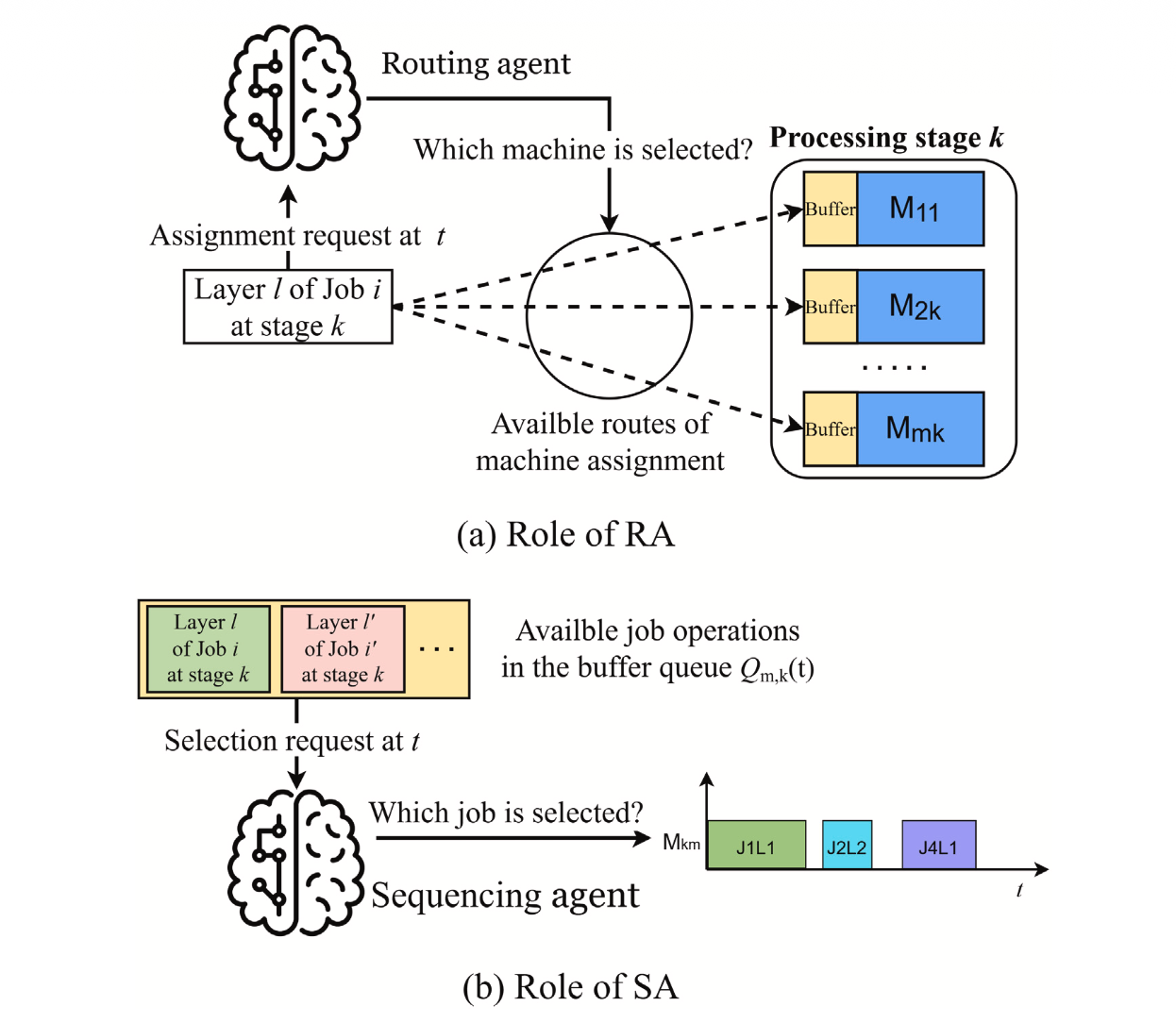
The team led by Liu Yong focused on complex scheduling optimization in smart manufacturing. Their paper, A modified multi‑agent proximal policy optimization algorithm for multi‑objective dynamic partial‑re‑entrant hybrid flow shop scheduling problem, was published in the prestigious AI journal Engineering Applications of Artificial Intelligence. The research proposes a dual‑agent collaborative scheduling mechanism, effectively improving the stability and performance of the algorithm, thus providing methodology for intelligent scheduling optimization.
The team led by Liu Chen published a research paper titled Graph node embedding by neighborhood prediction based on multiview contrastive learning in the journal Knowledge‑Based Systems, which focuses on AI and knowledge engineering. The study presents a graph contrastive learning method, enhancing graph representation capabilities and offering a new technical means for anomaly warning and root‑cause analysis in industrial scenarios.
3. Healthcare: New Progress in AI‑Based Diagnostic Research
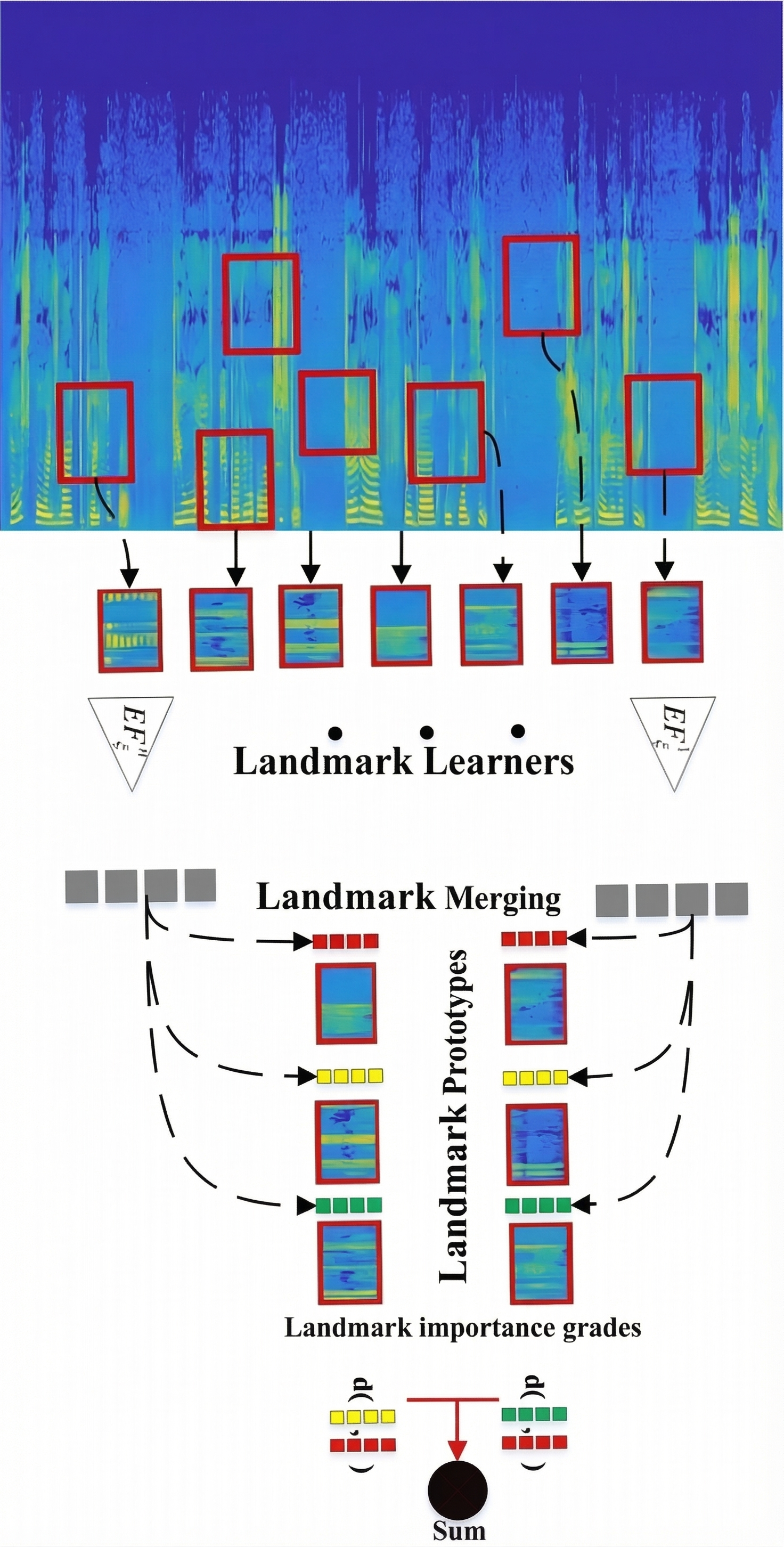
The team led by Yin Pei tackled the few‑shot learning problem in medical diagnosis. Their paper, A cognitive few‑shot learning for medical diagnosis: A case study on cleft lip and palate and Parkinson's disease, was published in the computer‑science journal Expert Systems with Applications. The research proposes a cognitive few‑shot learning framework, alleviating issues such as limited sample size and labeling difficulties in medical settings, and provides a new research direction for AI‑empowered medical diagnosis.
4. Urban Mobility Governance: Smart Transportation ResearchContinues to Deepen
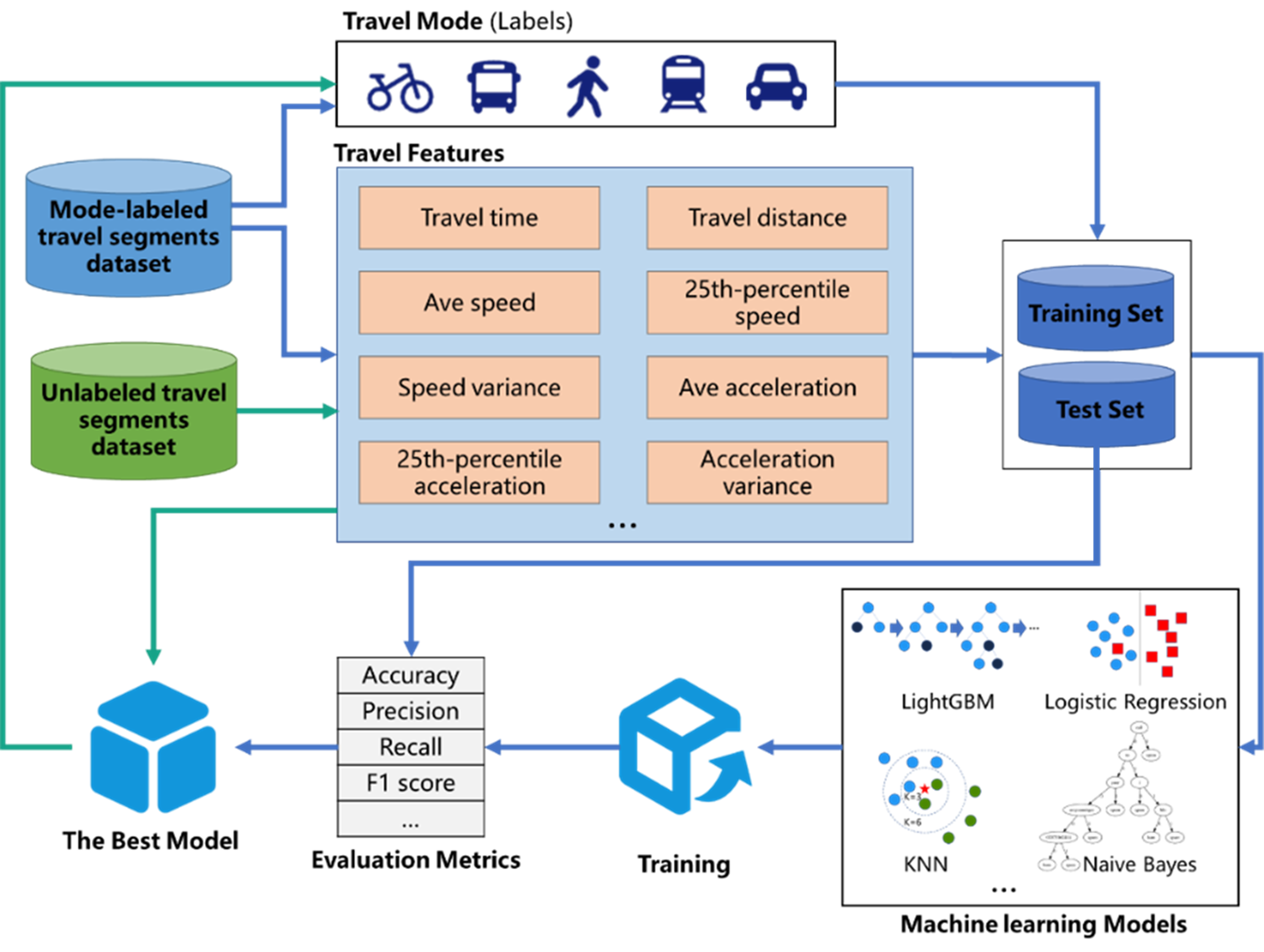
The team led by Li Wenxiang investigated the understanding of complex travel behaviors of urban residents. Their paper, Understanding multimodal travel patterns based on semantic embeddings of human mobility trajectories, was published in the international transportation‑geography journal Journal of Transport Geography. The study identifies multi‑modal travel patterns, offering a new method for understanding complex urban travel behaviors, optimizing transportation facility allocation, and improving the granularity of traffic governance.
The team led by Wang Ke published a paper titled Heterogeneity in Women's Nighttime Ride‑Hailing Intention: Evidence from an LC‑ICLV Model Analysis in the top‑tier transportation journal Transportation Research Part A: Policy and Practice. By integrating machine‑learning clustering concepts with discrete‑choice models, the research quantifies women's nonlinear risk preferences toward nighttime ride‑hailing, providing empirical evidence for ride‑hailing platforms to optimize route planning, improve risk‑warning mechanisms, and inform transportation‑policy formulation.
In recent years, the Business School has consistently adopted problem-, application- and innovation-oriented approaches, promoting the integration of AI technology with fields such as systems management and industrial intelligence. The School has innovatively explored the AI‑SMART talent‑cultivation system. Centered on a five‑stage progressive framework—Start(foundation), Method(algorithm/technology), Application(practice), Research(frontier exploration), Transformation(application transfer)—the system aims to cultivate high‑level interdisciplinary talents who possess systems thinking, master core AI technologies, and can solve complex system‑management problems. The School insists on transforming research strengths into educational advantages, converting industrial needs into teaching content, and turning real‑world scenarios into training platforms, thereby continuously deepening the integration of research and education. In the future, the School will continue to focus on major national strategies and industrial‑development demands, further synergize organized research with high‑level talent cultivation, promote more high‑quality research outputs, and train more high‑level interdisciplinary AI talents.
List of Papers:
[1] Liu Y, Li J, Zhang Z, et al. Identification and management of non-cooperative behaviors in large-scale group decision-making: Review, taxonomy and challenges from an LLM perspective[J]. Expert Systems with Applications, 2026: 131876.
[2] Wu J, Liu Y. A modified multi-agent proximal policy optimization algorithm for multi-objective dynamic partial-re-entrant hybrid flow shop scheduling problem[J]. Engineering Applications of Artificial Intelligence, 2025, 140: 109688.
[3] Chen Liu, Xuan Yao, Lixin Zhou. Graph node embedding by neighborhood prediction based on multiview contrastive learning[J]. Knowledge-Based Systems, 2026, 334: 115026.
[4] Yin P, Song J, Bouteraa Y, et al. A cognitive few-shot learning for medical diagnosis: A case study on cleft lip and palate and Parkinson’s disease[J]. Expert Systems with Applications, 2025, 262: 125713.
[5] Li W, Ding L, Zhang Y, et al. Understanding multimodal travel patterns based on semantic embeddings of human mobility trajectories[J]. Journal of Transport Geography, 2025, 124: 104169.
[6] Wang K, Yao D, Ye X, et al. Heterogeneity in Women’s Nighttime Ride-Hailing Intention: Evidence from an LC-ICLV Model Analysis[J]. Transportation Research Part A: Policy and Practice, 2026, 206: 104903.
Translated by Wei Xin
Reviewed by Liu Weiwei