
At the recently concluded IEEE/CIC International Conference on Communications in China (ICCC) 2025, a paper co-authored by Associate Professor Shao Shuo from the Business School of USST and collaborators was awarded the Best Paper Award alongside ten other papers, standing out among 1091 global submissions.
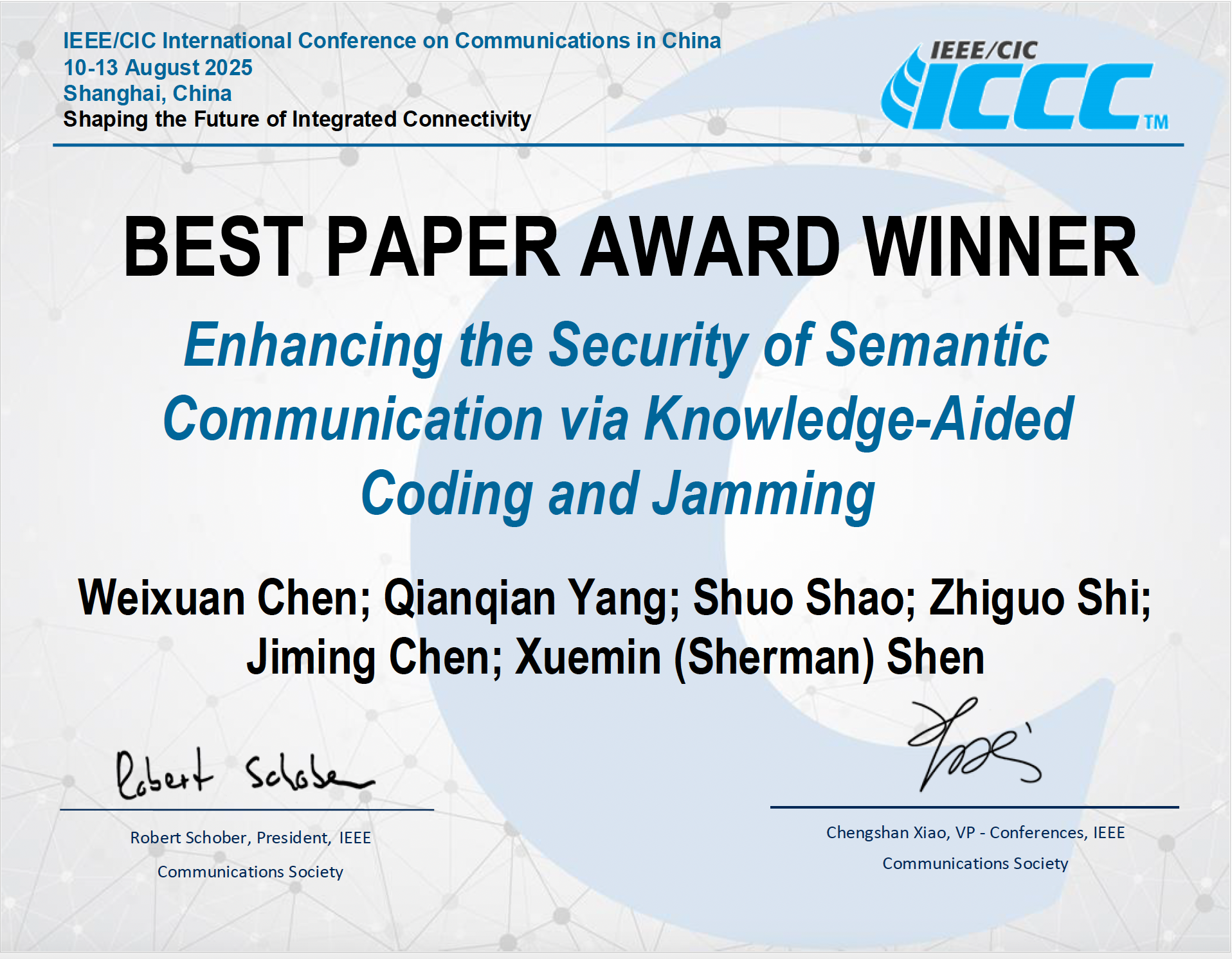
The winning paper, titled “Enhancing the Security of Semantic Communication via Knowledge-Aid Coding and Jamming”, proposes a novel approach to address eavesdropping risks in wireless communication. By leveraging neural networks to encode transmission and jamming signals separately and enabling legitimate users to decode jamming signals via a shared knowledge base, the technique significantly reduces information leakage to eavesdroppers while improving communication efficiency for authorized users. This breakthrough provides an efficient solution for 6G secure intelligent communication. The co-authors include researchers from Zhejiang University, Hangzhou Dianzi University, and the University of Waterloo, Canada.
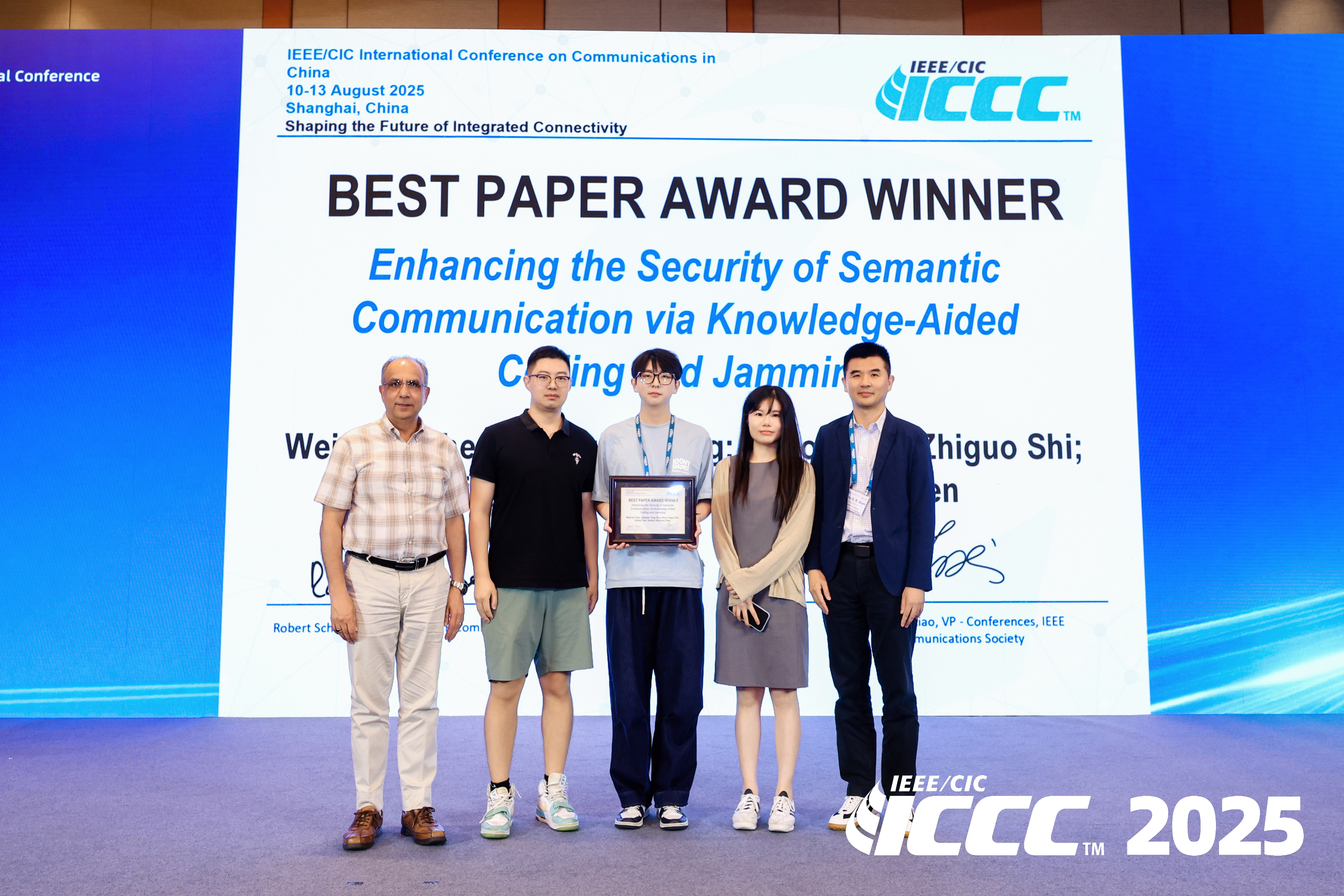
Semantic communication, a critical research direction for 6G, faces inherent security challenges in open wireless environments. The paper’s innovation lies in its integration of coded jamming with shared knowledge, offering a robust defense against eavesdropping compared to traditional noise-based jamming methods.
Held from August 10 to 13, 2025, in Shanghai, the conference was co-organized by IEEE, IEEE ComSoc, and the China Institute of Communications (CIC), with Fudan University as the host. Under the theme “Shaping the Future of Integrated Connectivity”, it gathered over 700 global experts to explore cutting-edge trends through forums, workshops, and technical demonstrations.
Shao Shuo earned his B.E. in Information Engineering from Southeast University (2011), an M.Sc. from McMaster University (2013), and a Ph.D. from Texas A&M University (2017). He served as Assistant/Associate Professor at Shanghai Jiao Tong University (2017–2025) before joining USST in 2025. His research focuses on information theory-based intelligent communication systems, with over 40 publications and a previous Best Paper Award at IEEE WCSP 2022. His work is supported by grants from the National Natural Science Foundation of China and Shanghai's Rising Star Program.
Translated by Wei Xin
Reviewed by Liu Weiwei